
22 Nov, 2026Akshit Mandial
How Monk CI Keeps Docker Cache Warm
See how Monk CI retains Docker build cache across ephemeral runners, which inputs trigger rebuilds, and how to verify reuse in your workflow.
A fresh CI runner is useful. It gives a job a clean place to start.
It can also lose yesterday's useful build work. If Docker cache lives only on the runner, a new machine may have to rebuild layers the team has already built.
Monk CI addresses that problem by giving temporary compute and reusable Docker state separate lifecycles.
Two lifecycles, one build
The runner executes the job. BuildKit manages the Docker build and decides which earlier results still match its inputs.
Monk CI's public engineering description keeps reusable build state beyond the lifetime of one runner. That lets a later job start in a fresh environment while still using eligible work from earlier builds
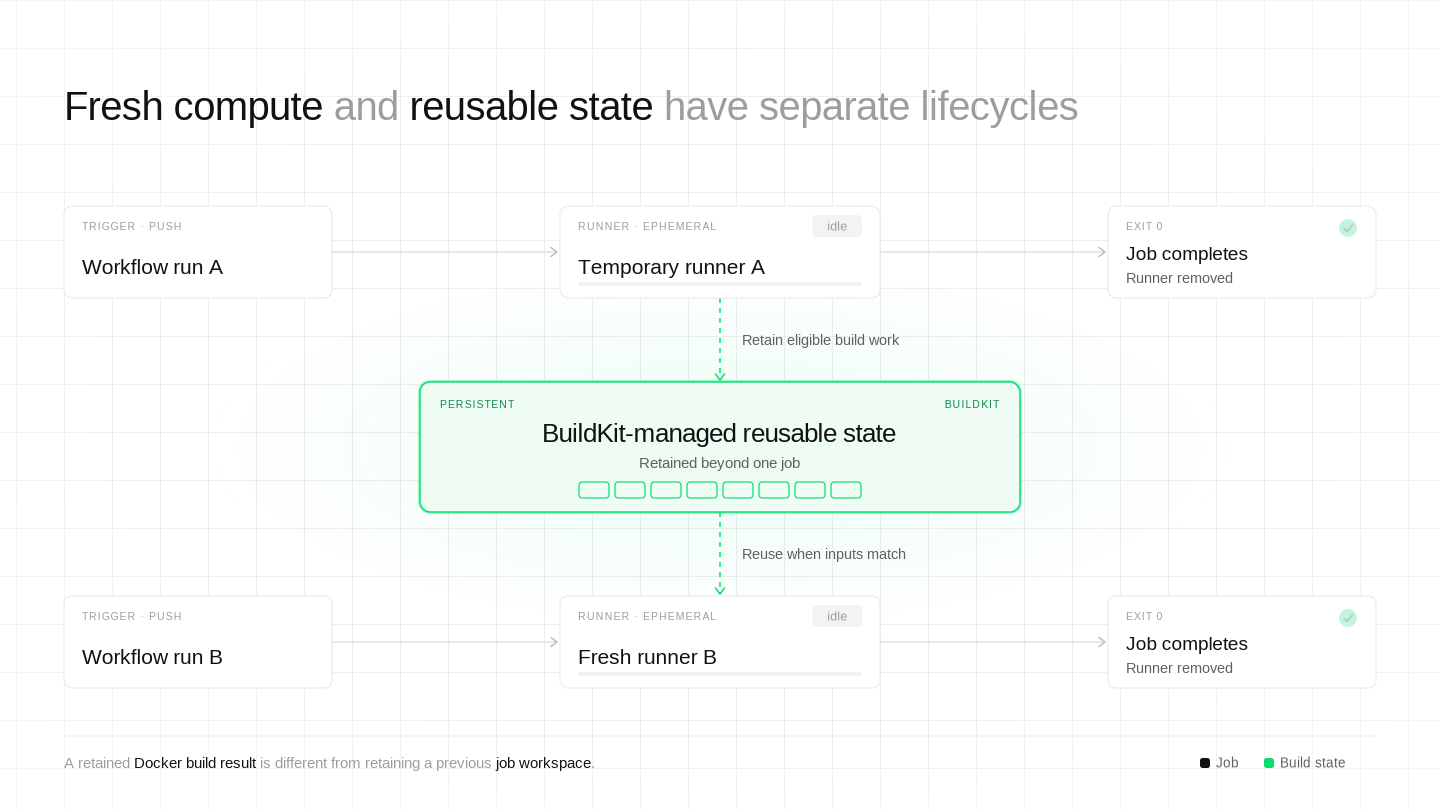
This does not mean the next job inherits the previous job's whole filesystem. A saved Docker build result and a leftover workspace are different kinds of state.
The benefit shows up in ordinary edits
Take a small Node.js application:
FROM node:22-bookworm-slim
WORKDIR /app
COPY package.json package-lock.json ./
RUN npm ci
COPY . .
RUN npm run build
With matching earlier inputs and an available cached result, a source-only edit can reuse the package-install step. The app build still sees the new code.
If install scripts need app files, copy those required inputs before running them. And when package manifests change, a fresh install is expected.
The Dockerfile defines the work that can match. Keeping state available gives BuildKit a chance to reuse that work.
What changes compared with other setups?
Keeping a long-lived self-managed runner can preserve local cache, but the team also has to manage that machine's workspace, storage and lifecycle.
A fresh runner with no retained or external Docker cache gives a clean start, but loses that local reuse path. GitHub Actions can also use exported cache, including gha or registry cache, to carry build work between jobs.
Monk CI provides a managed retained-cache path for its Docker workflow. The practical value is shorter repeated builds where useful work matches, without keeping an entire runner alive solely for its cache.
When comparing managed builders, check workflow fit, full job time and operating effort.
Warm state still has boundaries
Cache reuse depends on the build inputs and available state. It is not a promise that every new job will be warm.
A changed base image, different build arguments, missing entries or reclaimed state can require more work. A larger cache also cannot repair an undeclared dependency in the Dockerfile.
Fresh runners do not make secrets copied into Docker layers safe. Those files can become part of retained build data. Use proper build-secret mechanisms and keep sensitive files out of the image.
Check the behavior you care about
Use Monk CI's current Docker setup guide, which pairs its setup and build actions. A runner-label change alone does not complete that Docker integration.
Then try an unchanged rebuild, a source-only edit and a dependency edit. Compare step logs as well as the full job duration.
Start with one service before expanding the setup across a monorepo.
Takeaway: clean job environments and useful build reuse can coexist. Keep them as separate responsibilities, and test both.