
20 Nov, 2026Mahesh Kale
CI Queue Time: Warm Pools vs On-Demand Runners
Understand warm pools and on-demand CI runners, where queue delays come from, and how to compare startup time, burst capacity, and cost on Monk CI.
Your tests finish quickly, but the job waits to start. Faster test code won't remove that queue delay.
Warm pools address one part of this wait: getting compute ready. To judge their value on a CI service such as Monk CI, it helps to split the path from queued job to first step.
Ready compute is one part of readiness
With on-demand provisioning, a job can trigger machine creation, boot, and setup. A warm pool does some of that work before the job arrives, holding prepared capacity for later use.
The word “warm” needs context. For example, AWS documents warm-pool instances in stopped, running, or hibernated states. Those choices have different resume times and costs. This is a general infrastructure example, not a description of Monk CI's cloud provider.
A prepared VM also isn't the same as an online GitHub runner. The runner must be available to the repository and match the job's labels and group. GitHub then has to assign the job.
Where the shorter path can end
Prepared capacity reduces some startup work while leaving other waits in place
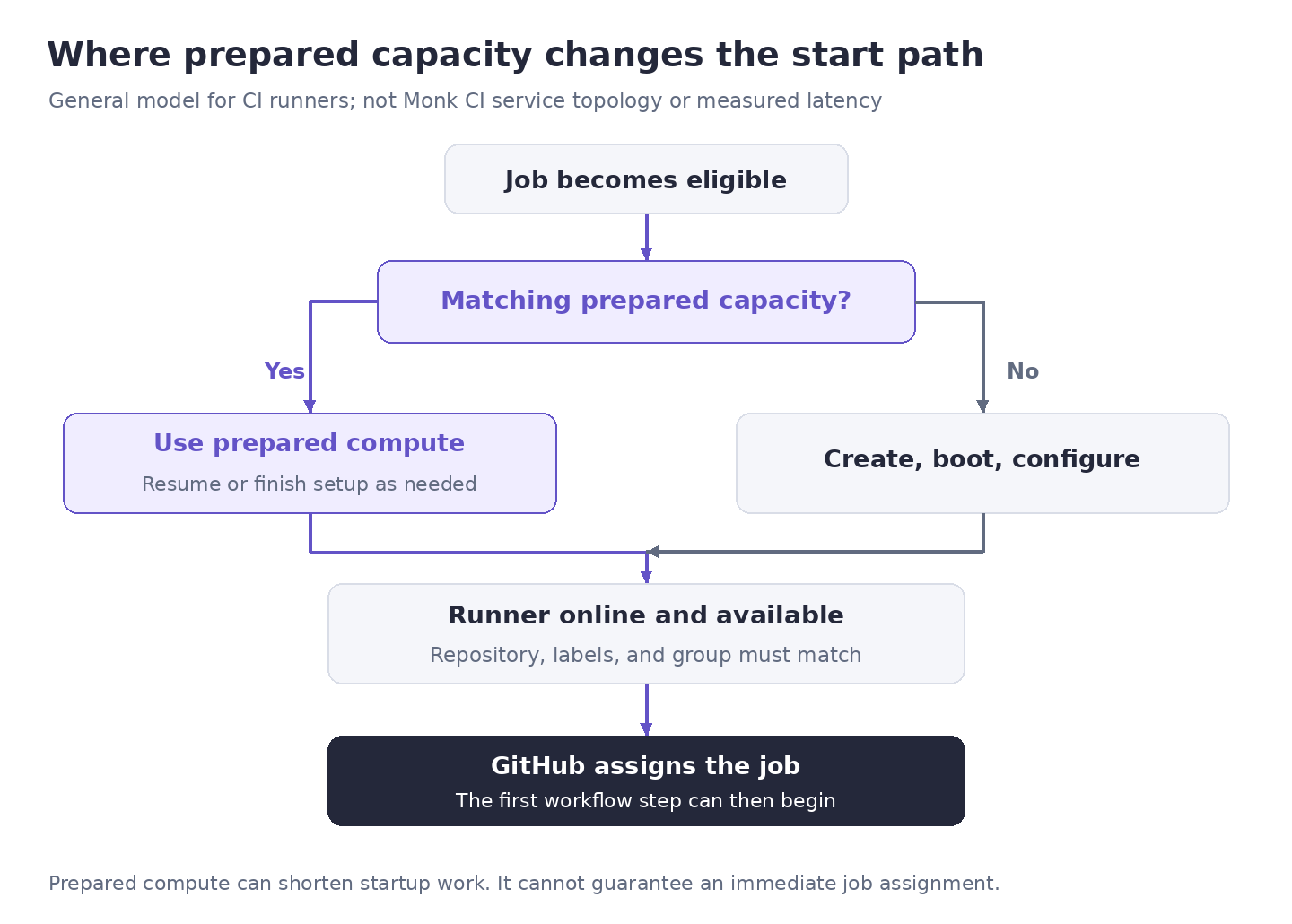
General scheduling model. This does not show Monk CI's internal service topology or promise a start time.
Picture a burst of ten jobs and four ready workers. If all four workers match those jobs and are free to accept work, at most four jobs can take that ready-capacity path at once. The remaining jobs still need capacity or must wait.
That's an illustrative case, not a measurement from Monk CI. It exposes the tradeoff: the pool needs enough of the right capacity, and it needs time to refill after a burst.
The bill moves when the wait moves
Keeping prepared capacity has a cost. Running machines may consume compute while idle; stopped machines can still incur storage charges. Provisioning only when work arrives reduces standing capacity, but places more startup work on the job's path.
A steady stream of jobs may keep prepared runners busy. A few unpredictable jobs each day may leave a large pool mostly unused.
For a managed service, the provider runs that capacity system. You should judge the result through observed start times and the plan's actual price. Don't treat a provider's internal idle cost as a direct item on your invoice.
Measure the delay you can act on
For GitHub Actions on Monk CI, record what you can see: when a job becomes eligible, when it starts, and when its first step begins.
Keep these cases separate:
- A job waiting for a dependency or a concurrency limit.
- A job with no matching ready runner.
- A ready runner waiting for assignment.
- A started job spending time on checkout, downloads, or setup.
Compare typical waits with the slower tail, such as the 95th percentile. Test bursts at your runner size, rather than relying on one run. A warm runner also doesn't prove that dependency or Docker caches are warm; those have separate lifecycles.
Takeaway: Prepared compute can shorten the startup path. The useful test is whether jobs start sooner under your real arrival pattern, at a cost that makes sense for your team.